
The Quarterly Reset: A Retrospective Framework for Impact Startups
TL;DR — Key Insights from Régy, BergenGrowth:
Most impact startups treat quarterly planning as a fresh start instead of a learning continuation, and it costs them focus, time, and money.
At BergenGrowth, I've spent 100+ hours on creating goal setting and retrospectives. I observed that impact founders who skip structured retrospectives repeat the same mistakes: activity-based goals, scattered priorities, and vanity metrics that look impressive but don't predict revenue.
The BergenGrowth Quarterly Reset Method is a three-layer retrospective framework (Outcomes, Alignment, Direction) that connects your past quarter to your North Star Metric before you set new OKRs.
After working with 60+ impact startups across climate tech, agrifood, and regenerative business, I've found that the retrospective is where the real strategic clarity happens, not the planning session.
The Problem: Why Quarterly Planning Rarely Sticks for Impact Startups
Every quarter, the same thing happens. Founders start planning their ambitious objectives, assign key results, and move on. The previous quarter? Already forgotten.
I worked with one urban greening social enterprise running over twenty active propositions simultaneously with a core team of four. Neighbourhood campaigns, an advisory platform, a new financing model, municipal projects, European subsidy programmes.
When I asked what the previous quarter had taught them about which propositions were generating traction, the answer was honest: they hadn't looked.
This isn't unusual. It's often the norm for impact enterprises.
Teams set goals that look good on paper but don't move the needle on what actually matters.
Key results measure activities ("launch onboarding sequence") instead of outcomes ("increase retention from 40% to 60%").
And the same structural problems occur: scattered focus, misaligned messaging, too many revenue streams for a small team. Carry forward quarter after quarter because nobody stopped to name them.
At BergenGrowth, I've facilitated quarterly planning sessions with dozens of early-stage startups from regenerative agriculture companies to climate tech hardware ventures.
Three Patterns That Separate Startups Who Improve From Those Who Don't
Pattern 1: Measuring What You Did Instead of What Changed
The most common pattern I see: key results that describe completed activities rather than outcomes.
The correction was subtle: "Onboard new farmers" became "increase expressing concrete interest in partnership from X farmers to Y farmers, by Q2." The shift from output to outcome changes everything about how you evaluate your quarter.
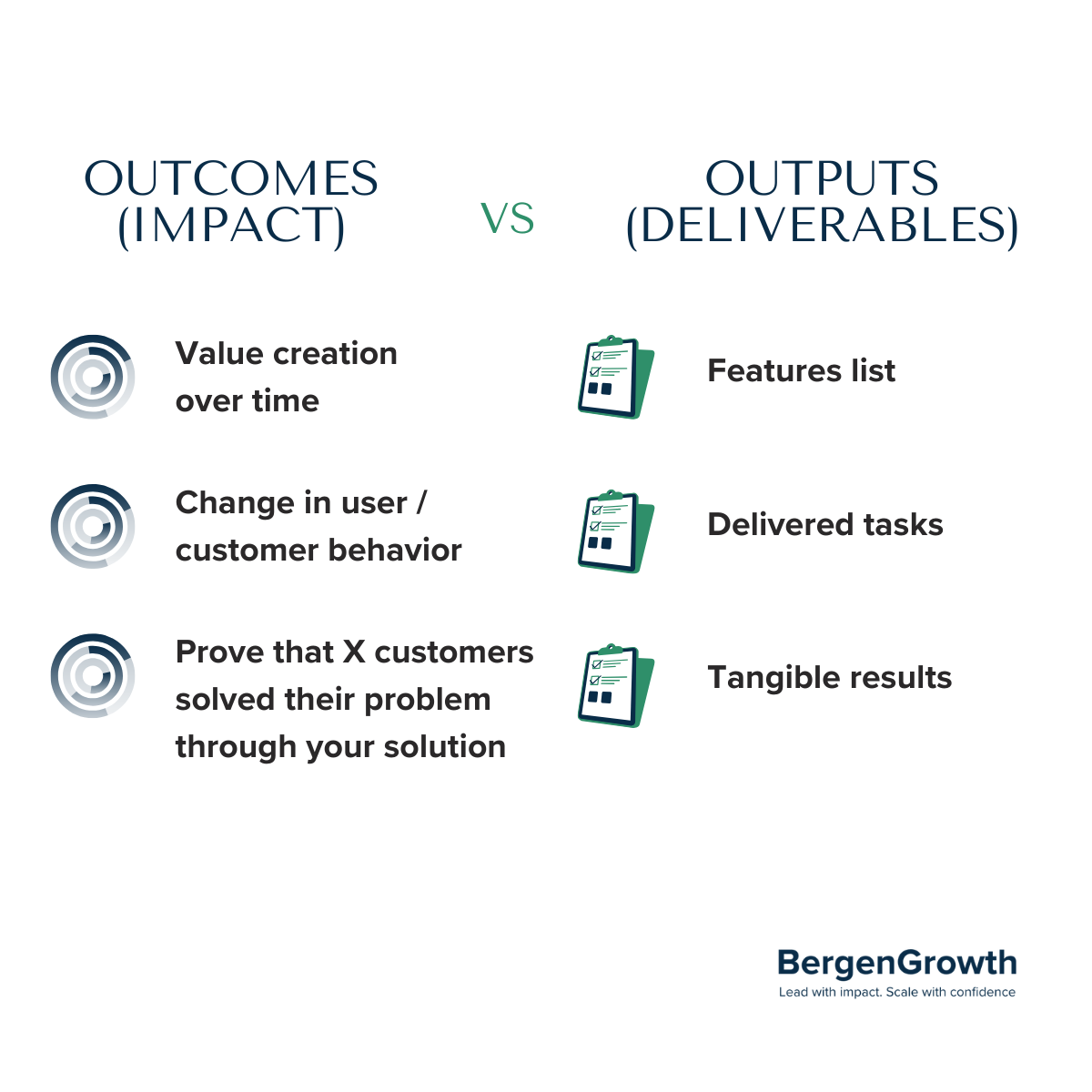
BergenGrowth | Outcomes vs Outputs
What changed after the reset: Once that team rewrote their goals around outcomes, their weekly check-ins became diagnostic conversations. They stopped celebrating completed tasks and started asking whether the work had produced the intended change. Within one quarter, they could clearly see which initiatives were moving things forward, and which were consuming capacity without creating impact.
Pattern 2: Strong Metrics, Wrong Signal
I worked with a startup in the Rockstart portfolio who had impressive conversion numbers: 100% from first meeting to deep dive, 70% from deep dive to proposal. But retention after pilots was falling. Clients were hitting agreed KPIs and still questioning whether to continue.
The front-end metrics looked like success. The business was showing churn. Without a retrospective that asked whether the metrics were actually measuring customer value, that disconnect would have continued indefinitely.
The fix: restructuring onboarding from Day 30 check-ins to Day 0/7/14 touchpoints with customer decision-maker involvement. By completing 80-90% of the primary outcome on day zero — not day thirty — retention improved immediately. Users stayed because they experienced real value from the first session, not because the team chased them.
Pattern 3: Internal Consensus Without External Validation
In one accelerator cohort, a team spent twenty minutes presenting strategic decisions they had made internally — without validating those decisions against customer feedback or their previous quarter's results. They had mistaken internal agreement for market signals.
This is particularly common in impact startups where mission conviction is strong. The team believes deeply in their solution, so they skip asking whether last quarter's hypothesis was right.
The result: When structured customer validation became part of their quarterly process — at least five external conversations before any strategic shift — their confidence moved from opinion-based to evidence-based. The next quarter's goals were grounded in what prospects had actually told them. Resulting into a sharper value proposition and a clearer market understanding.
BergenGrowth | outcomes vs outputs impacting North Star Metric
The BergenGrowth Quarterly Reset Method
Three layers. One honest conversation before the next planning session begins.
Layer 1 Outcomes Review: What Actually Happened?
Start here. Before discussing the future, walk through the past quarter through three lenses.
What went well? Which key results did you hit? Which initiatives created measurable change — not just output, but something that moved? If your core business metric moved, understand exactly what drove it.
What could have gone better? Not to assign blame, but to learn. Did you hit a key result without creating the value you intended? If the target was "secure five pilot customers" and you did — but none converted — you hit the number and missed the signal. Was the target wrong, the approach wrong, or the metric wrong?
What questions remain unanswered? Surface the decisions, conversations, and tasks where you either need help, see roadblocks, or realise the answer redirects your priorities. These unanswered questions are often the most valuable output of a retrospective. They reveal what you didn't know you didn't know.
The essential question for this layer: Did your core business metric (North Star Metric) look different at the end of the quarter than at the start? If it didn't move despite hitting your key results, your goals were disconnected from what the business actually needed. That gap is worth understanding before you set new ones.
Layer 2 Alignment Check: Are We Focused?
This layer addresses the structural problem I see in nearly every impact startup: meaningful mission, limited team, and more active priorities than the organisation can genuinely support.
For teams under ten people, more than three or four real priorities usually means none of them gets what it needs. The alignment check is about naming that honestly, not as a failure, but as a structural reality that requires a deliberate choice.
Prioritize time and energy.
Map your active value propositions against your actual team capacity. Count effective full-time equivalents. Be honest about how much of the founder's time goes to operations versus strategy versus sales. Then ask: how much of our capacity is each proposition actually receiving?
Identify what you should have said no to.
Most founding teams discover a significant gap between the number of things they are pursuing and the capacity available to pursue any of them well. That gap is the conversation. Not "what should we cut?" — but "what deserves our full attention first, so it can carry the rest later?"
This is also where the regenerative principle applies most directly. Tending one thing well before expanding isn't just a business strategy. It's how regenerative systems work. You don't scatter seeds — you plant deliberately, tend carefully, and let what grows create the conditions for what comes next.
Synthesise the themes.
Before moving to Layer 3, take the output from Layers 1 and 2 and synthesise the themes.
What patterns emerged across what went well, what didn't, and the unanswered questions? Group them.
Then assign accountability and ownership: who works on which priority, and what specifically will they move in the next quarter?
This synthesis step is where focus gets created. Without it, you walk into direction-setting with the same scattered energy that defined the previous quarter. The goal is to commit as a team and to set clear priorities before you write a single OKR.
Layer 3 Direction: What Do We Commit to Next Quarter?
Only after completing the first two layers does it make sense to set new goals. This sequence matters. Goals set without retrospection are usually a repeat of last quarter's goals with different numbers.
Direction-setting at this layer means three things:
Choose the primary metric. One number that tells you whether the quarter moved the business forward. Everything else is context.
Set outcomes, not activities. "Increase willingness-to-pay validation from X to Y qualified conversations" is an outcome. "Project launched" is an activity. The distinction shapes every weekly check-in that follows.
Name what you are not doing. The hardest part of direction-setting for impact founders is the explicit decision to set something aside. Not permanently, but deliberately, for this quarter. What goes on the waiting list so that something else gets the attention it needs?
New OKRs should pass three tests:
Does this OKR move our North Star Metric? If you can't draw a clear line from the key result to your NSM, the OKR doesn't belong in this quarter.
Is the key result an outcome, not an activity? "Onboard new farmers" is an activity. "Shift from 100% project-based revenue to 25% recurring service-model revenue" is an outcome — it measures a structural change in how the business creates value.
Can our team realistically pursue this alongside our other OKRs? If you have three objectives with four key results each, that's twelve measurable outcomes for one quarter. For most early-stage teams, two objectives with three key results each (six total) is the realistic ceiling.
Then commit. Starting the new quarter means everyone knows their priorities, their ownership, and how their work connects to the North Star. No ambiguity.
What This Looks Like in Practice
A regenerative urban composting company I work with made this exact shift: moving from one-off composting installations to a maintenance partnership model that generates recurring revenue without requiring the founder's personal involvement in every project.
A regenerative food startup came into their quarterly reset with five revenue streams: corporate catering, retail partnerships, direct-to-consumer, event catering, and a subscription box. Each was generating small amounts — none was sustainable. Their retrospective revealed that one channel (a single corporate partnership) was producing more reliable revenue than the other four combined. Their new quarterly OKRs focused entirely on replicating that partnership model with three similar prospects. The other channels were paused, not abandoned — but they stopped consuming the team's limited time.
A climate tech hardware company had been measuring "number of pilots launched" as their primary key result. Their retrospective revealed that pilot count was a vanity metric — what mattered was pilot-to-contract conversion and the unit economics within each pilot. They redesigned their OKRs around cost validation and offtake agreements rather than pilot volume. The shift meant fewer pilots but dramatically higher quality engagement with each prospect.
How to Run Your Own Quarterly Reset
Time required: 2-3 hours for the full process. Don't try to compress this into 60 minutes.
Who should attend: The founding team plus anyone who owns a key result. This is not a board meeting or investor update — it's an operational conversation.
Preparation (before the session): Each key result owner prepares a one-paragraph honest assessment: what happened, what the metric showed, and what they learned. No slides. No performance theatre.
During the session: Spend the first 60-90 minutes on Layers 1 and 2 — walking through what went well, what could have gone better, and the unanswered questions, then checking alignment and focus. Use the synthesis step to identify themes and assign accountability before moving on. Only spend the final 60-90 minutes on Layer 3 (Direction Setting). Most teams do the opposite — rushing through reflection to get to planning — and that's exactly why the same problems repeat.
After the session: Your new OKRs should be finalisable within 48 hours. If they're not, you haven't achieved enough clarity in the retrospective. Go back to Layer 2.
Frequently Asked Questions
-
Always before. At BergenGrowth, I see startups make this mistake constantly: they set exciting new goals first, then retrofit a retrospective to justify decisions they've already made. The retrospective is where you earn the right to set new direction. Layer 1 and Layer 2 of the BergenGrowth Quarterly Reset Method should be completed before you open a blank OKR document.
-
Yes, arguably more. Pre-revenue startups should run retrospectives focused on validation metrics rather than revenue metrics. Did you validate a customer assumption? Did you get closer to problem-solution fit? Did your conversations with prospects change your understanding of the buyer? Pre-revenue retrospectives prevent the most expensive mistake: building something nobody will pay for.
-
If your OKRs were achieved but your NSM didn't move, one of two things happened: your OKRs weren't connected to your NSM, or your NSM doesn't actually capture the core value you deliver. The retrospective is the right moment to evaluate this. At BergenGrowth, I recommend reviewing your North Star Metric fit once per year, but checking its connection to your OKRs every quarter. For more on choosing the right NSM, see our guides for SaaS companies and impact startups.
-
Reframe the purpose. A retrospective is not a performance review — it's a diagnostic. At BergenGrowth, I use a simple rule: no retrospective finding should name a person. Instead, name a pattern. "We set activity-based key results" is actionable. "Marketing didn't deliver" is blame. If your OKRs are designed around outcomes (see our OKR implementation guide), the retrospective naturally focuses on systems and choices rather than individual performance.
-
The retrospective sits at the transition point in the BergenGrowth Goal Stack Framework. Your North Star Metric stays constant (it defines success). Your annual strategy evolves slowly. But your quarterly OKRs should shift meaningfully based on what you learned. The retrospective is the mechanism that converts last quarter's learnings into next quarter's direction. Without it, your OKRs become a repeated wish list rather than an evolving strategy.
About BergenGrowth
BergenGrowth is a GTM advisory consultancy specialising in helping impact startups — in climate tech, agrifood, renewable energy, and regenerative business — scale from Seed to Series B. The frameworks are grounded in real GTM advisory work across top European Impact accelerator programs including Impact Hub Amsterdam, Rockstart, and RESPOND. Learn more at bergengrowth.com.
Last Updated: April 2026 | Author: Régy Bergen, BergenGrowth
